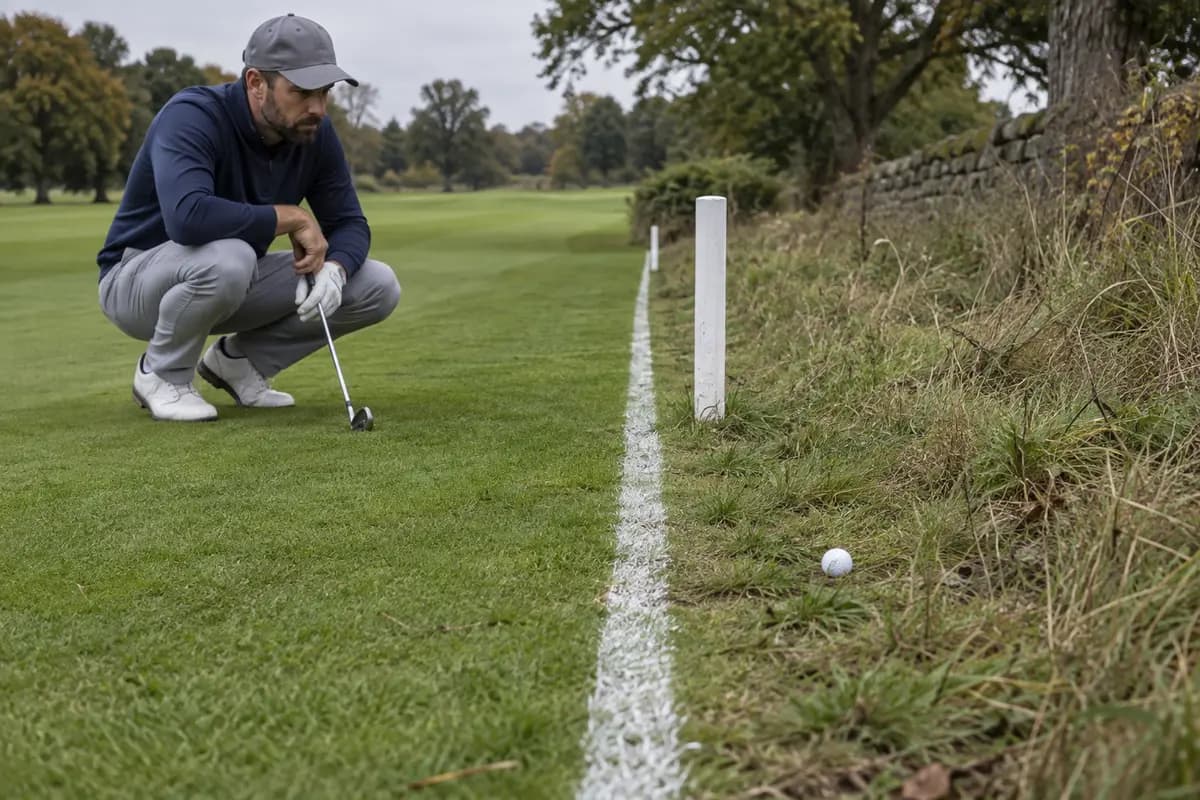
All of the ball must be outside.
If any part of the ball lies on or above the boundary edge, it is in bounds. When the entire ball is outside, the standard procedure is one penalty stroke plus a replay from where the previous stroke was made.
A practical three-step procedure
The Committee defines the boundary. Check the scorecard and Local Rules: stakes use the line between their course-side points at ground level; a painted line uses its course-side edge. The edge extends vertically up and down.
- 1
Identify the Committee’s boundary
Confirm which stakes, lines, fences or other objects define out of bounds for the round.
- 2
Apply the whole-ball test
Look along the vertical boundary edge. If any part of the ball is in bounds or overhangs the edge, the ball remains on the course.
- 3
Use stroke and distance
If it is out, add one penalty stroke and play from the previous spot. A correctly announced provisional can save the walk back.
If your out-of-bounds miss is a slice
A ball will not fix a slice, but lower long-game spin can sometimes limit how far a curved shot finishes offline. Find Your Ideal Golf Ball explains the trade-offs and when this choice makes sense.
What else matters
Drive 1 + penalty 1 + replay = your third stroke.
A correctly played provisional becomes the ball in play when the original is confirmed out.
- Boundary objects give no free relief. Stakes, fences and walls defining out of bounds are not movable obstructions.
- Do not take a one-stroke drop beside the crossing point. Model Local Rule E-5 applies only when adopted and costs two strokes. It is unavailable when the original is known or virtually certain to be in a penalty area, or for that original after a provisional has been played.
- Announce a provisional before going forward. “I’ll hit another” is not a clear provisional announcement.
- Your stance may be outside the boundary. The ball’s position determines whether it is in bounds; where you stand does not.
Remember: Whole ball out. Previous spot. One penalty.
Rule 18 and Local Rule E-5
Independent plain-English guide. The current Rules, the Committee’s boundary definition and Local Rules control.
Watch out of bounds and provisionals explained
Watch the official explanation here without leaving the guide. The complete written guidance remains above for quick reference.